You may never have heard of a community forest, but this form of working land protection has been in use in New England since the early 1990s. A community forest requires the collaboration of many stakeholders – residents, government agents, and NGOs alike – in the management of a forestland. There is no one set definition of a community forest; in their evolution they can be “as diverse as the communities who own and manage them.”
What makes these forests unique from other private or government-owned forests is the essential role that local residents play in their stewardship. The community decides the goals and objectives for the land, determines the governance, and collects the social, cultural, and economic benefits of the forest. It is truly a model of community conservation.
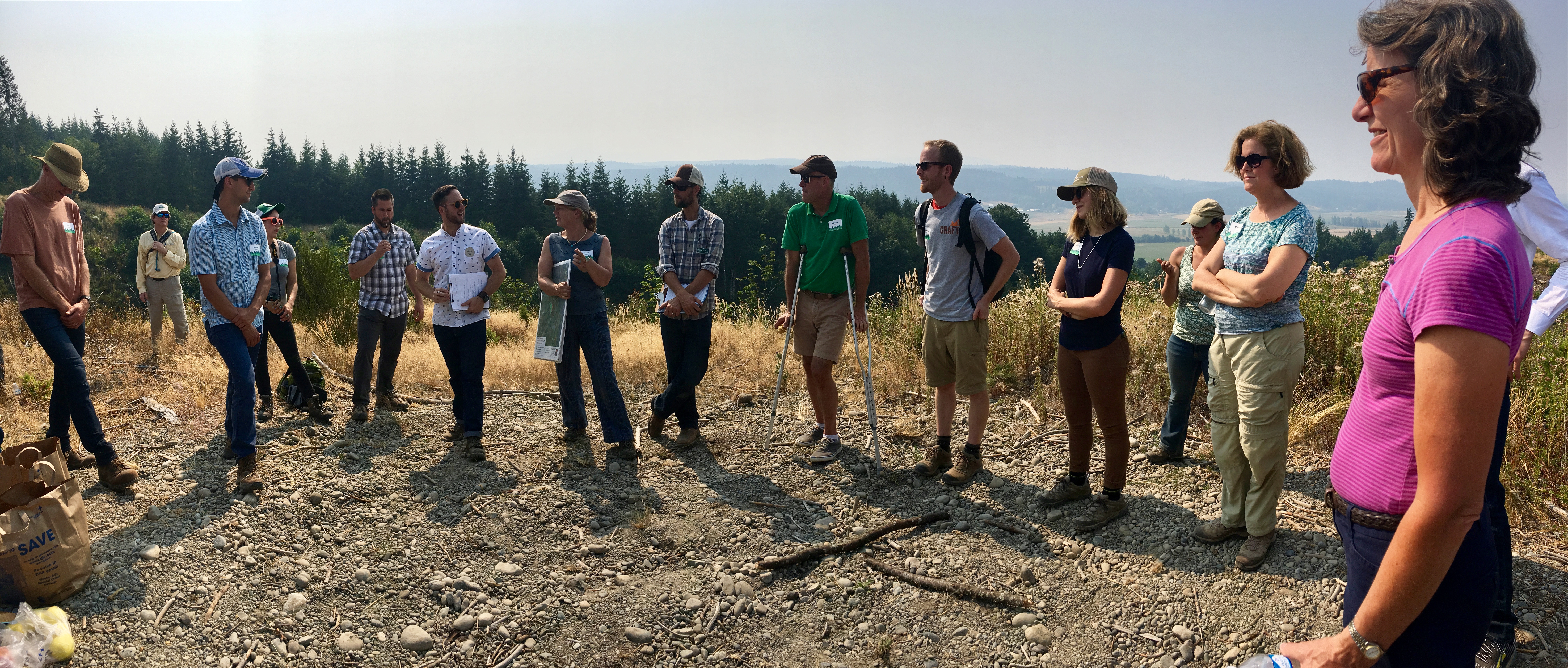
This August, Jefferson Land Trust and Sustainable Northwest hosted a tour of Chimacum Ridge forest – where Jefferson Land Trust and the Chimacum community are working to establish a community forest in an amazing example of how community forests are forging the way for community conservation. The Washington Association of Land Trusts, together with members of the conservation community, policymakers, and locals, learned about this forest and its role in the watershed as part of the 2017 Northwest Community Forest Coalition Field Tour in Chimacum, Washington.
Conservation at a watershed-scale
This forest’s story is woven into the fabric of deeply collaborative community conservation at a watershed-scale, following the path of salmon-bearing Chimacum Creek. The 2017 Field Tour took participants from the creek’s estuary, through Chimacum’s rich agricultural valleys, and to the upland forests where the creeks headwaters originate, highlighting along the way the community partnerships that created a strong, versatile, and deeply relevant local conservation movement that integrates ecological wholeness and community health.
Restoring salmon habitat of Chimacum Creek
In its early days, Jefferson Land Trust’s work had a primary focus on protecting salmon habitat, particularly at the mouth and lower reaches of Chimacum creek after a culvert had blown out and wiped out the summer chum run there. An enormous community effort brought the chum back, and forged partnerships that have been integral to protecting salmon habitat in multiple watersheds on the Olympic Peninsula.
However, said Sarah Spaeth, Jefferson Land Trust Director of Conservation and Strategic Partnerships, “The fate of salmon doesn’t rest in the lowest reaches of the creeks. The health of salmon follows the water.”
Protecting land that honors farms and fish alike
“If we follow Chimacum Creek upstream we come to Chimacum’s rich agricultural valleys,” noted Spaeth. “These farm fields represent the next evolutionary step of conservation in the Chimacum watershed. Seeing that generational turnover and a changing agricultural economy was putting local farms at risk, we formed community partnerships focused on preserving and supporting working lands.”
Since then, Jefferson Land Trust has worked with farmers to protect over 800 acres of farmland for agriculture and salmon habitat in the Chimacum watershed alone. “Since then we have seen a local food and farm revolution in Chimacum, and the creation of an agricultural movement that honors farms and fish alike.”
“Our farmers care about the salmon, and see how farming and fish can both thrive. They get it – it’s all connected. And it doesn’t stop there – this story, and these connections, continue with the path of the water.”
Working Forests of Chimacum Ridge
Chimacum Creek’s headwaters originate in the working forests that rise above the farm valleys. These working forests are an important part of local heritage, economy, way of life and community character–and working forests are at risk much as local farms once were. This represents the next step in the evolution of conservation in the community, and the next stop for participants of the Coalition field tour: Chimacum Ridge.
On Chimacum Ridge, an 850-acre working forest property that rises over this landscape of protected farms and salmon habitat, Jefferson Land Trust is now working with a group of partners, including Ecotrust Forest Management and Washington Environmental Council, to establish a community forest.
As a community forest, they envision managing the land for multiple community benefits. Selective ecological timber harvest would bring in revenue, protect water quality, wildlife habitat and the environment while letting a healthy, mature forest continue to grow. They envision this land providing business opportunities, outdoor classrooms for local school groups, and recreational access and trail connectivity to the community below.
“I know for some folks, cutting trees and conservation can seem like odd bedfellows,” said Spaeth, “But, just like farming and salmon, they don’t have to be. We’re talking about forest management that benefits the forest in the long run, making it healthier, more diverse, and more productive. This timber management could be a foothold for local wood products as powerful to our community as local food has become.”
Protecting lands in partnership
Jefferson Land Trust and partners from the North Olympic Salmon Coalition, Blue Zones, the Northwest School of Wooden Boatbuilding, Ecotrust Forest Management, Finnriver Farm and Cidery, Jefferson County, and the Washington Environmental Council discussed the evolution and impact of conservation in Chimacum.
The tour concluded with a roundtable discussion about different models for governing and funding community forests. One such model is Washington’s DNR Community Forestry Trust program which helped acquire and manage the Teanaway Community Forest. Members from the DNR attended the tour and were there to engage the Northwest Community Forest Coalition and WALT in how make this program more effective for conservation organizations and their communities.
An important regional crossroads
The location of Chimacum Ridge, within the context of the area’s greater conservation narrative, and by its incredible location in a vibrant rural center at an important regional crossroads, makes it a perfect candidate for a community forest. Demonstrating sustainable forest management practices in such a prominent and visible spot could make this place be a powerful ambassador for managing forests in a different way, honoring all the benefits they provide, and generating income that can support care of the land and give back to the community.
Community forests are a natural complement to Jefferson Land Trust’s strategic vision of landscape-level conservation. With the integrated strategy of protecting “fish, farms, and forests”, Jefferson Land Trust protects and strengthens their community’s working lands to restore critical habitat, drive regional economic development, and empower their local community.